Friday, December 22, 2006

Cypress Trees & Bayous

(Originally published in the Wilderness Explorers newsletter)

Harrison County, Texas

We were glad to be back in Texas. After having gallivanted all over the southern states and as far east as North Carolina, we were overjoyed to see that sign on the state line as we left Louisiana—“Drive Friendly, the Texas Way”! Other places are nice to visit, but there’s just no place like the Lone Star State.

Our final camping-out destination for the trip was Caddo Lake State Park near Karnack, Texas, just across the border. Although off the beaten path, this was a place we really wanted to see, since Caddo Lake is the biggest, if not the only, natural lake in Texas.

By the time we got there it was dark, but the next morning we got a good look at the place. Being in far east Texas, the trees were very tall, and there were so many kinds! It was just neat to actually be in a forest, since we don’t really have those in our neck of the woods.

That morning as we were packing up the tent, we found a very gigantic millipede. It was so big it looked like it must have escaped from the zoo! But there it was, crawling among the dry leaves. I did pick it up, knowing of course that centipedes sting, not millipedes.

After breakfast we decided to go canoeing. Upon inquiring at the park headquarters, we learned that Caddo Lake proper was a good distance down the bayou from the state park, and that it would take us a few hours if we expected to make it that far.

But we rented a couple of canoes anyway, and paddled out across Saw Mill Pond. This pond (a view of which is pictured above) was unlike any pond I had ever seen before. There was a great abundance of cypress trees, and estimating the size of the pond was very difficult due to this fact. As we were pushing off from the shore, we saw a great blue heron (Ardea herodias) standing among the lily pads, the same type of bird of which I wrote in the January 2006 issue. I was in possession of the camera at that time, and I was able to get a few pictures of the curly-necked bird.

Although much of the pond was covered with lily pads (whether native or not, I do not know), there was a path carved through them which led out of Saw Mill Pond to the bayou. You can ask Deborah about lily pads; she has a great dislike for them due to a bad experience at Fort Parker State Park.

Once we left the pond to paddle the bayou, however, there were no more lily pads. When we reached Big Cypress Bayou, we went to our left, the opposite direction from Caddo Lake. The bayou was very wide and deep, and lined with cypress trees on both sides.

Nearly all the cypress trees there were decked with Spanish moss, which gave them an old, gray appearance. Although the moss anchors itself to the branches of these trees, it is not a parasite, as might be expected. In fact, its roots serve merely to hold onto the branch, and the moss gets all the nourishment it needs from the air.

By all appearances, the bayou along which we were paddling seemed much like a river. In fact, until just recently I did not know the difference between these two terms. Although both bayous and rivers are channels of water, the difference is that bayous flow very slowly (some even contain stagnant water), whereas rivers are usually faster-moving. Also, bayous tend to be wide, and rivers come in all sizes.

After we had gone a good ways down the bayou, we went under a bridge. Shortly after that we decided to turn back and start heading back to the pond.

As we turned our canoes and reentered Saw Mill Pond, we spied a heron among the lily pads, presumably the same one we had seen earlier. As Deborah and I were fighting our way through the lily pads on an alternate route (how did Daddy talk us into that?), Mommy had the camera and was closely following the movements of the bird, waiting for it to take flight. Finally it did, and she was able to get an excellent photograph of the heron in mid-air, along with a splash of water.

Once the canoes were landed, we decided to go on the nature trail not too far off. The trail led through the forest among the tall trees, and here and there were interpretive signs, alerting us to the fact that we had just entered a different vegetation zone, and containing other pieces of information.

Having already looked at the map, I decided to take the trail labeled “Steep Rugged Footpath”, which led away from the nature trail. Daddy went with me, and Deborah and Mommy continued following the nature trail and went back to get the car. We agreed to meet them at the other end of the Steep Rugged Footpath, where it met the road.

Although the trail had a formidable title, for us who are used to hiking mountains in New Mexico, this one was easy to conquer. It did go uphill for a while, but it was nothing too difficult. As we went along, I marvelled at all the different types of trees and plants that were there, and took pictures of some of them. At one point along the trail I even spotted a five-lined skink (Eumeces fasciatus), with a bright blue tail. We don’t see skinks very often around here, and as far as I know there is only one species of skink in Parker County, the ground skink. It’s not every day that you see a lizard with a blue tail, and although I pursued it with the camera, it got away from me.

Daddy and I soon arrived at our point of rendezvous, and were soon picked up by Deborah and Mommy. Although we could have stayed longer at the state park, we had everything packed up already, and we were ready to head home. So once we were back in the car we left the state park, although we had one more stop we wanted to make before we headed west.

On the park map, I saw an arrow pointing north next to FM 2198, which was labeled “To Uncertain”. Having heard of that place before, I knew what it meant, and I was eager to go. There is nothing spectacular about Uncertain, Texas, but even though it was a little out of our way, we didn’t want to miss the opportunity to visit this little town when we were so close.

So to Uncertain we went, although we weren’t sure how far up the road it was. We knew for sure that we had reached it, however, when we saw the city limit sign. We couldn’t resist the chance, and we all got out to take our picture by the sign.

After that, we were really ready to go home. We bade farewell to east Texas, and drove west, back to our home in Parker County.

Labels: , ,

Friday, November 3, 2006

Dragons of the Sea

Tennessee Aquarium, Chattooga

While in Chattanooga, we had the privilege of going to the Tennessee Aquarium. This complex is housed in two different buildings, and contains all manner of fish and crustaceans, not to mention many other water-loving creatures. The otters were great, the paddlefish fantastic, the piranhas fearsome, but the part I enjoyed the most was the room of seahorses.

Although not in the ocean building, this room held aquariums filled with every type of seahorse imaginable, including pot belly sea horses (that's right!). Even aside from displaying these odd-looking fish, signs on the tanks told of all their interesting characteristics.

As I went around the room, peering into each tank and noting which species lived in each, I marveled, though not too greatly. We all know what seahorses look like, having seen them in books, but when I came to one tank, I was simply astonished. The creatures inside resembled seahorses, but they were bigger, and were unlike anything I had ever seen. As I looked at their long trumpet-like noses and their bodies that resembled clumps of seaweed, a thought entered my mind—These look just like dillapedes! And indeed they did. These creatures—sea dragons they're called--looked like a product of my imagination, something that might have jumped off the pages of my Dillapedia and came to life.

There are two kinds of sea dragons, leafy ones and weedy ones. The leafy sea dragons are metallic green, but are not quite as leafy as the weedy sea dragons, which look like they're sprouting leaves all over.

I believe sea dragons really show God's creativity. While all the other creatures and plants show His handiwork and design as well, it's these strange-looking ones that really grab your attention, and make you think, "I bet He had fun making those!"

Labels:

Friday, October 20, 2006

The Vine that Ate the South

Nearly Everywhere

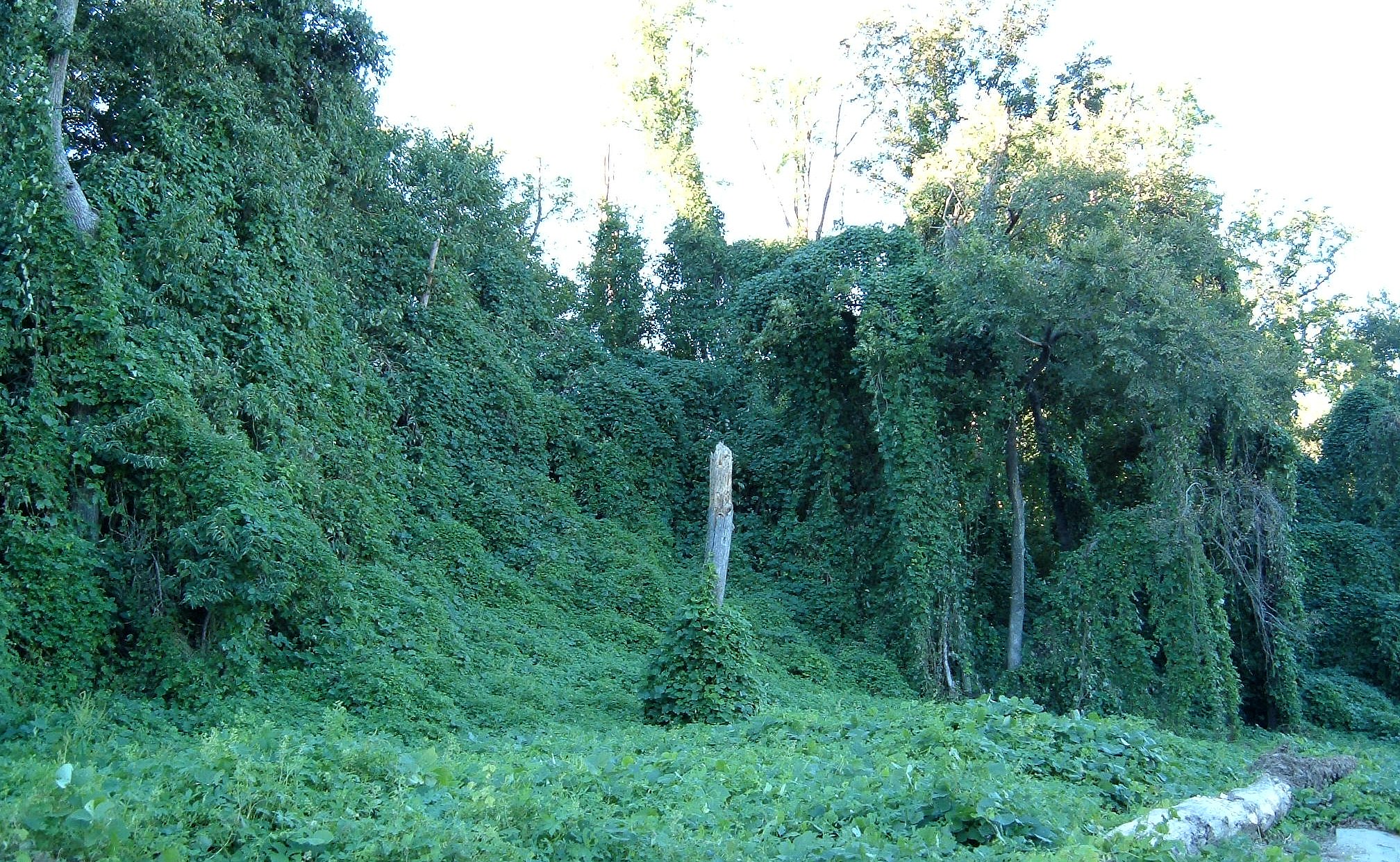
It's green. It's big. It's hungry. What is it? Kudzu. According to Internet research I've done, the vine often grows at a rate of a foot a day. As we traveled throughout the southern states, we saw it quite frequently by the side of the highway—a green blanket covering everything, trees, telephone poles, you name it. It's not a native species, in fact it originated in Japan and China. So how did it get here?

It all started at the U.S. Centennial Exposition in 1876, when Japan had a display including kudzu. From there the vine became quite popular, promoted as a forage crop and also for ornamental purposes. The Civilian Conservation Corps even planted it, and was considered a good cover plant by the U.S. Department of Agriculture.

However, years later, people finally realized that this amazing vine was actually taking over! It grew everywhere, and it wasn't until 1953 that it was recognized as a pest weed. Today they are trying to contain the boundless vine, and although we didn't see them there, I have heard that they are using goats to eat the kudzu foliage in Chattanooga, Tennessee.

Sometimes it's said that southerners close their windows at night to keep the kudzu from growing in, and I wouldn't be surprised if it's true in some places. Other names for kudzu include "mile-a-minute vine," "foot-a-night vine", and my sister's favorite, "the vine that ate the south." It is certainly an unsightly plant, and hopefully something will be discovered soon that will remedy this problem.

After reading about this terrifying plant, aren't you glad it hasn't gotten to Texas yet? I was until I read this webpage.

For more information about kudzu, look at The Amazing Story of Kudzu.

Labels:

Friday, October 13, 2006

Across the Smokies

Tennessee & North Carolina

The day was fairly sunny in eastern Tennessee as we drove towards the Smoky Mountains, part of the Appalachian range. The great peaks loomed ahead of us, columns of mist rising from their slopes, as if many bonfires were raging there.

‘Twas from this that the mountains received their name, and it became no wonder to us as we entered the Great Smoky Mountains National Park.

Upon entering the park, we took Laurel Creek Road, which, as we figured, would take us straight to the Sugarlands Visitor Center. Although not as straight a shot as we expected, the winding road finally brought us there. In that area of the park, the mountains were not apparent since we were not yet in them, but the scenery was fantastic. One thing that never ceases to amaze us Texans is the size of the trees back east. They tower over you! You really have to put your head way back to see the top! And the trees here were no exception.

Besides the trees, there was also the roaring creek which the road followed. The water continuously rushed over the rocky stream bed, and many a family was fishing or playing in the water. We were content to watch as we drove by, since we were hoping to get to our campsite before dark to set up the tent.

Having visited the visitor center and procured a map, we set out on Newfound Gap Road. If you look at a map of the park, you will see that the national park is situated on the border of Tennessee and North Carolina, and includes a good portion of both these states. Our campsite was located on the North Carolina side of the mountains, so we took this road, the only one which crosses the highest ridge of the mountains.

As we traveled in a south-easterly direction, we could tell we were getting higher in elevation, and every once in a while there would be an overlook where you could look out at the mountains. Also as we ascended, it was clear that it was getting more and more foggy. As we neared the top, there were even more overlooks, some of which we stopped at to take pictures.

By the time we reached the top, we were in the middle of a cloud. We could hardly see anything out the car windows, but finally I spotted the sign by the road—“North Carolina State Line”. We were finally in North Carolina! I had never been to this state before, but now I was in it.

From that point we were going downhill, with the road as windy as ever. At one point we were astonished to see a yellow diamond-shaped sign depicting a loopty-loop, roughly the shape of the path commonly traveled by a roller coaster. We then found the sign had not deceived us—soon thereafter the road turned a full circle, and we went through a tunnel going under the point in the road where the curve began! I had never seen the like before.

At length we finally arrived to our campsite—Smokemont—and set up our tent. Even there it was misty, causing a very interesting effect—I do not know how to describe it. The Oconaluftee River roared not far off, and although everything was very wet, the temperature was moderate.

We had, for the first time, crossed the Appalachians into one of the original thirteen states—North Carolina, where the Bruces lived back in the 1700’s.


         View more photos from the Great Smoky Mountains

Labels: ,

Friday, August 11, 2006

The Music of Nature

This afternoon I was seated at my desk in my room, listening to some music, as I am wont to do. At 4:00 when I went outside to gather the eggs, the air was still just as blistering hot as before, but I heard some thunder and there was a dark cloud in the distance. When I got back in I unpaused my music. Not long after that, it began raining, and I ran outside and just stood in it, soaking it in. It hasn't rained here for so long that even the cacti are shriveling up! After a while I decided to go back in since it was thundering, and when I entered my room I thought about turning my music back on. However, I decided instead to open the window and let in some fresh air.

When I opened the window, the pleasant sound of raindrops falling on the ground came through like a soft breeze. I enjoyed this soothing sound until the rain stopped a few minutes later. As it ceased raining and a gentle wind began to blow, I thought about how wonderful the sound of rain is. I have a couple of CD's that have a song with sounds of rainfall, but no artificial sound coming from my speakers can compare with the beautiful music of nature.

Thus is my thought for the day. I encourage you to turn off your music and go listen to the music of nature. Even if it's not raining, I'm sure there are some birds out your window who would be willing to sing for you.

Labels: